


Energy Capital Collaboration Day
Energy Capital Collaboration Day
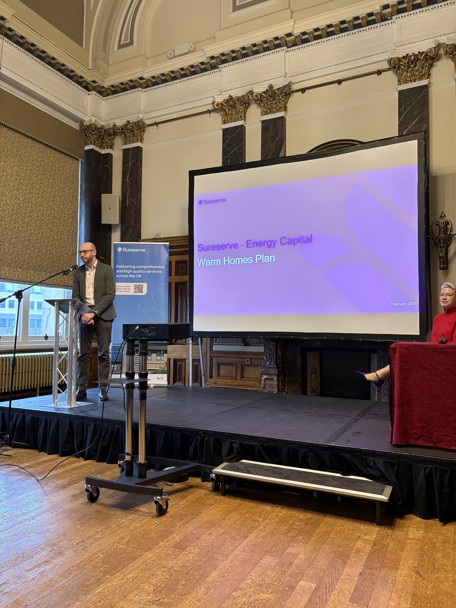
The February Collaboration Day was hosted in partnership with Sureserve to explore the impact of the Government’s Warm Homes Plan in the West Midlands.
Attendees heard from Selvin Brown, Director of Net Zero Buildings (Domestic), DESNZ about their vision for the Warm Homes Plan, and Energy Capital Director Cheryl Hiles about the role of Local Authorities and Combined Authorities in its delivery and what exactly it means for the West Midlands.
Throughout the morning there were panel discussions on the implications of the plan for social housing and fuel poverty, housing and homeowners, and non-domestic buildings, the public sector and infrastructure.
Key points from the event
• Selvin Brown from DESNZ presented reflections on the Government's published Warm Homes Plan, emphasising that it represents a comprehensive approach to addressing the cost-of-living crisis and fuel poverty affecting one in 10 households.
• DESNZ has secured a historic funding of £15 billion for the Warm Homes Plan, with £5.3 billion specifically allocated to households and existing schemes like the Social Housing Fund expanding from £200 million to over £4 billion.
• The Social Housing Fund has been extended from a four-year to five-year programme and will grow to £4 billion, representing one of the biggest retrofit programmes in government capability.
• The West Midlands Combined Authority confirmed their readiness to spend the government funding and highlighted how the Warm Homes Plan aligns with their regional energy strategy focused on consumer flexibility and an equitable transition.
• The regional energy strategy positions the West Midlands as a demand centre providing flexible demand to reduce generation and infrastructure costs while maintaining an equitable focus on homes as critical infrastructure.
• The new Warm Homes Agency will significantly impact consumer confidence and messaging coordination, addressing a key challenge in the retrofit market where inconsistent messaging has been destructive.
• Local government recognition as a key delivery partner enables place-based approaches and fundamental scaling up from small trials to substantial impact programmes.
• Sureserve outlined their role as a trusted partner in social housing and public buildings, highlighting their experience with the Scottish decarbonisation programme and their charitable foundation's work on fuel poverty elimination.
• Heat networks received significant attention with £355 million annual funding through the Green Heat Network Fund and government ambition to double heat generation by 2035, with 120% of heat from networks by 2050.
• The social housing sector faces a fundamental shift from discretionary retrofit projects to compliance-driven programmes, requiring providers to know their stock and articulate retrofit strategies to multiple stakeholders.
• Quality delivery emerged as the biggest risk in home upgrades, with Scottish experience showing 98% right-first-time results through 100% inspection rates compared to England's small percentage inspection approach.
• Strategic planning requires social housing providers to develop long-term approaches with plans for every property, moving from project-based applications to strategic partnerships with stakeholders.
• Panellists emphasised the urgent need to move from analysis to action, with one resident advocate stating that the cost-of-living crisis is literally killing people and immediate implementation is essential.
• Leadership commitment from chief executives is identified as the critical first step, followed by stock analysis and aggregated projects over 25 years to achieve the 4% annual decarbonisation rate needed by 2050.
Warm Homes Plan Publication and Funding
• Selvin Brown from DESNZ announced the publication of the Warm Homes Plan after extended delays, emphasising its comprehensive nature.
• The Government secured £15 billion in funding representing the highest amount of investment in the sector's history.
• Social housing funding received £8 million with targeting for 5 million homes through retrofits and fabric measures.
• The funding breakdown includes £5.3 million for households with additional match funding through existing schemes like the Social Housing Fund.
Cost of Living Crisis and Energy Poverty
• The Government has identified the cost-of-living crisis as the biggest challenge facing broader security planning.
• Energy costs significantly impact consumers with a 2% increase costing £20 to the average consumer.
• One in 10 households currently live in fuel poverty with government manifesto commitments to reduce these numbers.
• The Warm Homes Plan addresses these challenges through targeted investment and support measures.
Programme Implementation and Job Creation
• The initiative expects to create jobs increasing from 60,000 to 140,000 by the end of 2030.
• Implementation will utilise existing schemes initially with expansion planned over the coming years.
• The battery installation programmes faced temporary suspension due to technical standards issues but are expected to resume.
• The programme extends from a four-year to five-year timeline reaching £4 billion in total investment.
West Midlands Regional Energy Strategy
• The West Midlands Combined Authority positioned itself as a major demand centre for energy rather than focusing solely on generation capacity.
• Their regional energy strategy emphasises consumer flexibility and demand management to reduce infrastructure costs.
• The strategy aligns with national policy while maintaining focus on equitable transition and fair access to energy improvements.
• Local government partnership recognition enables place-based approaches to energy planning and delivery.
Warm Homes Agency Establishment
• The Government announced the creation of a Warm Homes Agency to provide consumer protection and support delivery activities.
• The agency will coordinate messaging and build consumer confidence in the retrofit market.
• Local authorities will work closely with the agency to ensure consistent messaging while maintaining regional flexibility.
• The agency structure aims to simplify the complex landscape of existing schemes and funding streams.
Social Housing Sector Transformation
• The plan shifts social housing from discretionary projects to compliance-based requirements under new standards.
• Housing providers must develop comprehensive stock knowledge and strategic planning capabilities.
• Long-term funding certainty enables providers to build sustainable supply chain relationships and apprenticeship programmes.
• Quality delivery becomes paramount with an emphasis on whole house approaches rather than piecemeal interventions.

Heat Networks and Infrastructure Planning
• The Green Heat Network Fund provides £355 million annually with ambitions to double heat generation by 2035.
• Heat network zoning introduces requirements for buildings in designated areas to connect where it is cost-effective.
• Birmingham and other West Midlands locations feature among the first 26 heat network zones in England.
• Technical assurance schemes will ensure heat networks perform efficiently and deliver low consumer costs.
Resident Engagement and Community Participation
• Effective resident engagement requires early planning and clear communication of benefits and disruption expectations.
• Social housing providers must integrate engagement into procurement processes and contractor requirements.
• Long-term engagement strategies need to extend beyond installation periods to ensure ongoing support and education.
• Community groups and resident organisations play crucial roles in identifying local needs and opportunities.
Quality Assurance and Delivery Standards
• Scotland's approach includes 100% inspection of installed measures achieving 98% right-first-time results.
• Quality delivery requires experienced site inspections throughout the installation process rather than just final checks.
• Market certainty through long-term funding commitments enables supply chain investment in quality and training.
• Technical standards and assurance schemes ensure consistent delivery across different programmes and regions.
Stock Assessment and Strategic Planning
• Housing providers need comprehensive stock analysis overlaying asset data with decency standards and energy performance.
• Strategic planning requires understanding of local stakeholder requirements including DNOs and local authorities.
• Place-based approaches enable coordination across different tenures and housing types within communities.
• Data collection and analysis capabilities become essential for accessing funding and demonstrating outcomes.
Next Steps
• Social housing providers will develop comprehensive stock assessment strategies and engage with the new Warm Homes Agency structure.
• The West Midlands will work with government to implement place-based delivery approaches and coordinate with network operators.
• Quality assurance frameworks will be established following Scottish models with comprehensive inspection regimes.
• Community engagement strategies will be integrated into all retrofit programmes with long-term support mechanisms.
• Funding applications will be prepared for the expanded programmes with emphasis on strategic partnerships and supply chain development.
To start the clean energy transformation conversation with us at Sureserve, click the contact us link below.
Post
-

To Reposition Net Zero as the People’s Hero: Restoring Public Support for Green Energy
23 Mar 2026
-

Warm Homes Plan: What It Means for Social Housing and the UK’s Solar Future
22 Jan 2026
-

Welcoming HI Group – Expert Solutions in Decarbonisation and Sustainability
09 Jan 2026
-

Sureserve Goes International
19 Dec 2025
-

Energy, Ideas and Optimism
02 Dec 2025